_edited.png)
Rethinking Trauma and Growth Through the ROI Lens

Updated: Feb 16
Dr. Jing Baer
Trauma isn’t just what happens to you. It’s what happens when support is missing. Learn how growth turns breaks into gold.
We often think of trauma as something that happens to other people: something dramatic, visible, and catastrophic. In reality, many people carry quieter versions of it. These are moments when life was simply too much, too soon, or too alone. These experiences don’t always meet the diagnostic definition of trauma, yet they leave lasting patterns in how we think, feel, and relate.
At Roiya, we see trauma not as a label but as an adaptation: the story of how your mind and body learned to protect you when support wasn’t enough. Because these adaptations are learned, they can also be updated.
Trauma as “Too Much, Too Fast, Too Alone”
Through the ROI (Role-Oriented Integration) lens, trauma isn’t only about what happened. It’s about the support you did not have when it happened, both during and after.
Trauma can be the moment you felt overwhelmed, and there was no one steady to help you regulate, protect you, or make sense of it with you.
That might look like:
A home where anger could erupt at any moment, so you were always bracing.
Years of being valued for performance instead of being seen as human.
Acting as the emotional support for a parent before you were old enough to need less support yourself.
A breakup or betrayal that shattered your basic sense of worth.
Long stretches of loneliness where you couldn’t afford to fall apart, so you didn’t.
In those moments, the body and nervous system do something adaptive: they create a role. The Fixer. The Caretaker. The Quiet One. The Overachiever. The One Who Never Needs Anything. Each of these roles is intelligent. Each one says, “This is how we’re going to get through this.”
The problem is not that these roles exist. The problem is that they often never get updated.
Why Old Patterns Keep Coming Back
Many people feel stuck in a loop: “I know what I should do. I’ve read the books. I’ve practiced the skills. I can explain my triggers. So why, when I’m stressed, do I still disappear, lash out, shut down, or say yes when I mean no?”
From the ROI point of view, the answer is simple: the survival role is still running.
When something in the present feels too similar to something overwhelming from the past, the old role steps in automatically. You don’t get a chance to “choose better.” Your system chooses safety. That’s not weakness; that’s memory.
This is why focusing only on correcting behavior (“just set boundaries,” “just calm down,” “just communicate”) often doesn’t hold under pressure. The role underneath hasn’t been reworked.
Healing as Role Update, Not Role Erasure
Healing isn’t about “stop being the Fixer.” Healing asks, “What was the Fixer protecting? Can that part of you rest now? Can someone else on your inner team take that job in a healthier way?”
In practice, this means:
Naming the role you developed when support was missing.
Understanding what it did for you.
Letting that role retire, soften, or share responsibility with a new role that fits your current life.
This is the core of post-traumatic growth.
What Post-Traumatic Growth Actually Means
Post-traumatic growth (PTG) doesn’t mean the trauma was good for you. It doesn’t mean “everything happens for a reason.” It’s not spiritual bypassing.
PTG means that after engaging with what happened (not avoiding it or numbing it, but truly working with it), you emerge with capacities you didn’t have access to before. People often describe:
Deeper self-respect
More clarity about what matters
More tolerance for their own emotions
Stronger boundaries
An ability to stay present in conflict without collapsing or attacking
In Chinese, there’s a phrase for this: 涅磐重生 (niè pán chóng shēng), meaning rebirth through fire.
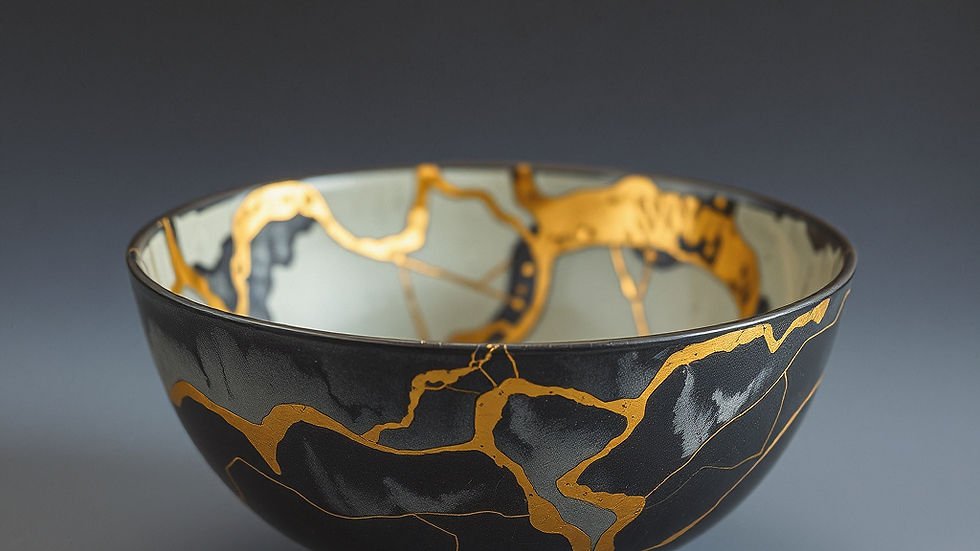
In Japanese art, there’s a practice called 金繕い (kintsugi), the repairing of a cracked bowl with gold, making it even more beautiful than before.
Both point to the same truth: healing doesn’t erase the break; it integrates it. The cracks become part of your design. The gold is what you’ve earned by facing yourself fully.
After trauma, you are not required to pretend nothing happened. You’re also not required to stay shattered. The work is to integrate the break in a way that makes you more coherent, more honest, and, in many cases, more powerful than before.
Not “back to how I was,” but “I understand myself in a way I never did, and I can move through the world with that understanding.”
That is post-traumatic growth.
A Quiet Form of Strength
People who have gone through this kind of work don’t usually describe themselves as “fixed.” They describe themselves as more themselves.
They can tell when an old role is trying to take over: “Ah, that’s the Peacemaker in me trying to keep everyone calm so I feel safe.” Then they can pause, breathe, and choose differently.
That pause is the gold seam. That pause is the rebirth.
Resilience, in this sense, isn’t pretending you’re fine. It’s being able to stay present with what’s real now instead of being pulled entirely into what hurt then.
That’s the shift: not erasing the crack, but living with it in a way that glows.
Pathways to Healing
At Roiya Center for Experiential Healing, we offer pathways for different needs:
Roiya Counseling trauma-responsive psychotherapy for deeper healing.
Roiya Lab prevention-focused workshops on boundaries, body awareness, and resilience skills.
Roiya Circle community talks, conversations, and connection without the therapy frame.
Roiya Intensive immersive programs for concentrated growth and role practice.
Safety note: This site isn’t monitored for urgent messages and isn’t for emergencies. If you’re in crisis or feel unsafe, call 988 (US) or your local emergency number right away. You don’t have to go through this alone.

Comments